Alpenglow in Alaska: Why the Mountains Turn Pink
There is a moment in Alaska when a familiar mountain can look completely new. The valley may already be in blue shadow, the air may feel still and cold, and then the upper slopes begin to blush. White snow turns peach, rose, or lavender. Rock catches a warm edge of color. A few minutes later, it is gone.
That brief transformation is alpenglow—one of those natural sights that asks almost nothing of us except that we notice. You do not need a ticket, a trail map, or perfect camera gear. You need an open view, the right light, and the patience to watch a mountain change.
What Is Alpenglow?
Alpenglow is a mountain-light phenomenon seen near sunrise or sunset. The name comes from the German Alpenglühen, meaning “Alpine glow,” but it is not limited to the Alps. It appears wherever mountains and low-angle light meet under the right conditions—including across Alaska.
The World Meteorological Organization describes a classic version that happens when the Sun is hidden from an observer at lower elevation while a mountain summit is still in direct sunlight. The top of the mountain takes on a rosy, pink, or yellow tint until Earth’s shadow climbs high enough to reach it. The same sequence can occur in reverse near sunrise. The term is also commonly used for the softer pink and red illumination that lingers around mountains during twilight.
That distinction helps explain why people sometimes disagree about what counts as “true” alpenglow. Some use the word only for indirect or reflected twilight light after the Sun has slipped below the horizon. Others use it for the direct red light that reaches a high summit after the ground below is already shadowed. In everyday Alaska conversation, both are likely to be called alpenglow. What they share is a fleeting wash of warm color on a cool landscape.
Why Do the Mountains Turn Pink?
Sunlight looks white, but it contains many colors. When the Sun sits low near the horizon, its light travels through more of Earth’s atmosphere than it does at midday. Molecules and particles scatter the shorter blue and violet wavelengths more strongly. More of the longer red, orange, and yellow wavelengths remain in the light that reaches distant peaks.
That warm light can be striking against Alaska’s usual winter palette. Snow reflects it clearly, while shaded slopes remain blue-gray or nearly black. The contrast can make a mountain seem lit from within, even though the effect comes from ordinary sunlight taking an extraordinary path through the atmosphere.
Snow is not required. Granite, tundra, cloud, and ice can all catch the color. Still, a snow-covered Alaska range often makes the transition especially easy to see because the light surface becomes a broad canvas for subtle shifts from gold to coral, pink, and violet.
Why Alaska Is Made for Alpenglow
Alpenglow is not uniquely Alaskan, but Alaska gives it a remarkable stage. Mountain ranges rise throughout the state, from the coastal peaks around Southeast and Southcentral Alaska to the Alaska Range and the remote Brooks Range at the edge of the Arctic. Broad valleys and open water can create long sightlines, letting the last light reach a summit while the observer stands in shadow.
High latitude also changes how we experience the Sun. In fall and winter, the Sun follows a lower path across much of the Alaska sky. Sunrise and sunset light can feel less like a quick border around the day and more like a season of its own. That does not guarantee alpenglow; clouds can hide the mountains, and the color varies with atmospheric conditions. But it gives Alaskans many reasons to pay attention to the edges of daylight.
The National Park Service regularly documents alpenglow across Alaska. Its photographs show pink and purple light on North America’s tallest peak in Denali National Park and spring alpenglow brightening the granite walls of the Arrigetch Peaks in Gates of the Arctic. Those places are vast and famous, but the phenomenon can also happen on the mountain you see from the kitchen window or the familiar ridge beyond town.
When and How to Look for Alpenglow
The best plan is simple: be ready shortly before sunrise or remain outside just after sunset. Find a clear view toward mountains, especially peaks that stand above the surrounding terrain. At sunset, the warmest glow is often easiest to notice on slopes opposite or offset from the setting Sun; at sunrise, reverse your attention.
A mostly clear horizon helps sunlight travel to the peaks, though a few clouds can add color and drama. Winter is a favorite season because snow makes the warm tones obvious, but alpenglow can happen in any season. The National Park Service even identifies a spring alpenglow on the Arrigetch Peaks.
Give yourself more than the one minute you expect to need. The first change may be so subtle that you wonder whether it is real. Then a pale summit warms quickly, reaches its deepest color, and fades. Looking away to adjust a camera or step inside can mean missing the best moment.
If you photograph it, expose for the bright snow rather than the dark foreground so the color does not wash out. A phone can capture the scene, especially if you tap the glowing peak to set exposure. But take at least a little time to watch without a screen. Alpenglow is beautiful partly because it cannot be held in place.
What Alpenglow Feels Like
Alaska teaches us to live with contrast: long light and long darkness, immense landscapes and small communities, hard weather and sudden beauty. Alpenglow gathers many of those contrasts into a few quiet minutes. The light is warm, but the air may be cold. The mountains look close enough to touch, yet remain far away. The day is ending, but the landscape briefly becomes more vivid.
That is why alpenglow can become more than a pretty color. It is a reminder to look up before the moment passes. It shows how an ordinary view can still surprise us. And during darker months, a pink summit can feel like a small promise that light is still moving across the land.
The Story Behind the Alpenglow Bracelet
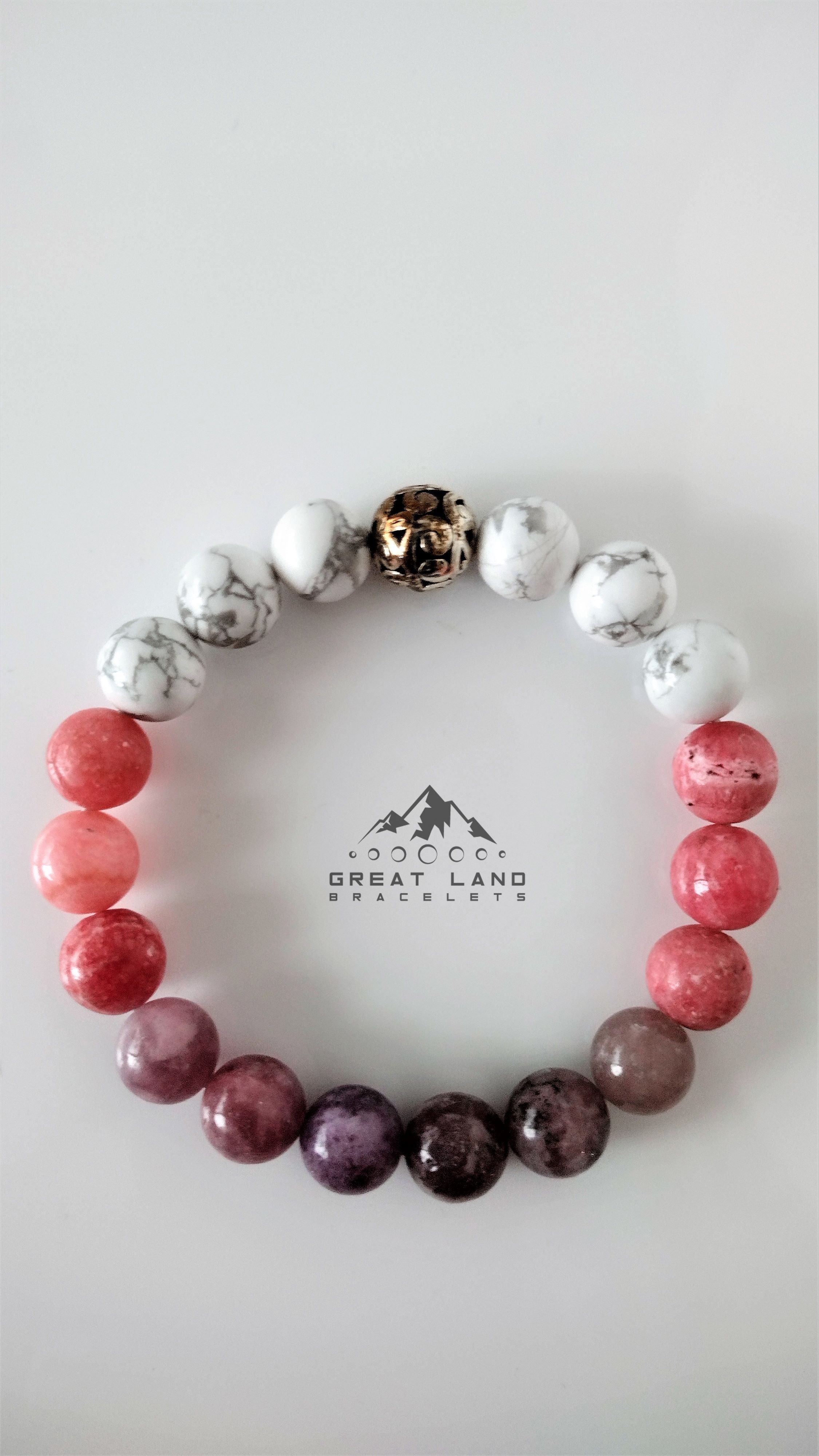
The Alpenglow Bracelet translates that winter mountain palette into natural materials. White howlite represents snow-covered peaks. Pink rhodochrosite and purple lepidolite echo the colors that move across the mountains as daylight fades. A silver focal bead recalls the clear, icy character of an Alaska winter.
It is not meant to reproduce one exact sunset. Alpenglow never looks exactly the same twice. Instead, the bracelet holds the memory of watching cold mountains turn warm for a few unhurried minutes. It can remind someone who lives here to keep noticing, or help someone far away carry a piece of an Alaska moment with them.
That is the heart of Wear your Alaska™: choosing a story from this place and keeping it close. Alpenglow may be brief, but the feeling it leaves behind can last much longer.
A Light Worth Waiting For
The next time the sky clears near sunrise or sunset, look toward the mountains. Watch the shadow line. Notice whether white slopes begin to turn gold, rose, or lavender. There may be no dramatic announcement—only a few minutes when the landscape catches the last or first warm light of the day.
That is enough. In Alaska, some of the most memorable experiences arrive quietly, stay briefly, and reward the people who were willing to look.
Sources: World Meteorological Organization International Cloud Atlas: Alpenglühen; NOAA NESDIS: Why Is the Sky Blue?; National Park Service: Denali National Park & Preserve; National Park Service: Gates of the Arctic National Park & Preserve.
-
Posted in
Alaska, Alaska mountains, Alaska photography, Alaska sunsets, Alpenglow Alaska, Alpenglow Bracelet, Wear your Alaska