
Brooks Range, Alaska: Mountains at the Edge of the Arctic
Across northern Alaska, a long wall of mountains separates the forested Interior from the Arctic. The Brooks Range stretches more than 700 miles from east to west, rising above broad river valleys, tundra, and some of the most remote country in the United States. There are no famous resort towns tucked beneath its peaks and only one public highway crosses the range. That remoteness is part of its character.
To see the Brooks Range is to encounter Alaska on a scale that is difficult to measure from a map. The mountains are not simply a scenic background. They shape rivers, weather, wildlife movement, plant communities, travel routes, and the lives of people who have known this country for thousands of years.
Where is the Brooks Range in Alaska?
The Brooks Range crosses northern Alaska from near the Canadian border toward the Chukchi Sea. The Bureau of Land Management’s Dalton Highway Visitor Guide describes a range extending more than 700 miles. The National Park Service identifies it as the northernmost extension of the Rocky Mountains.
The range lies largely north of the Arctic Circle. Its central mountains form the heart of Gates of the Arctic National Park and Preserve, while the eastern Brooks Range rises within Arctic National Wildlife Refuge. Between those protected landscapes, the Dalton Highway and Trans-Alaska Pipeline corridor cross the mountains at Atigun Pass.
Most of the Brooks Range has no roads. Travel commonly involves small aircraft, river routes, winter trails, or long wilderness journeys on foot. From the Dalton Highway, however, travelers can reach the range by road and see the dramatic transition from Interior forest to Arctic tundra.
A mountain boundary between two Alaskas
The Brooks Range forms part of the Continental Divide. Rivers on its northern side flow toward the Arctic Ocean. Rivers on the southern side join larger systems that eventually reach the Yukon River and the Bering Sea.
The divide is ecological as well as geographic. South of the mountains, spruce forests and boreal vegetation occupy many lower valleys. Moving north and upward, trees become scattered and then disappear. Alpine tundra covers slopes and high country, while broad treeless landscapes extend toward the Arctic coast.
According to the U.S. Fish and Wildlife Service, differences in elevation, slope, and exposure allow low tundra plants, dense shrubs, scattered poplar groves, and spruce forest to exist within the greater Brooks Range region. A traveler crossing the mountains can watch those habitats change over a surprisingly short distance.
The range also influences weather. Conditions can change quickly, and snow is possible during months that feel like summer elsewhere. Wind, fog, cold rain, and sudden loss of visibility deserve respect in every season.
Wildlife moving through the Brooks Range
Wildlife in the Brooks Range is often widely dispersed, but the mountains remain an important part of enormous seasonal movements. Caribou from several Arctic herds travel through valleys and passes between wintering and summer ranges. The National Park Service notes that animals from the Western Arctic, Teshekpuk, Central Arctic, and Porcupine herds move through the central Brooks Range.
Dall sheep use steep, rocky country where they can find food and escape many predators. Grizzly bears, wolves, wolverines, foxes, moose, and smaller mammals also live across different parts of the range. Golden eagles, peregrine falcons, ptarmigan, and other northern birds occupy the skies, cliffs, and tundra.
Wildlife should be watched from a safe distance. Never feed an animal or leave food where it can be reached. Along the Dalton Highway, pull completely into a safe parking area before using binoculars or taking photographs; the road remains an active industrial route used by large trucks.
A homeland, not an empty wilderness
The Brooks Range may appear unoccupied to a visitor looking across miles of roadless country, but it is not an empty place. Alaska Native people have lived, traveled, hunted, fished, and maintained relationships with this land for thousands of years. The National Park Service documents more than 10,000 years of human history in what is now Gates of the Arctic National Park and Preserve, with continuing subsistence traditions among local residents.
Communities within and near the greater range remain connected to rivers, wildlife, seasonal travel, and family histories rooted in the region. Visitors should avoid describing the country as untouched or uninhabited. Its roads may be few, but its human story is deep.
How can visitors experience the Brooks Range?
The Brooks Range is not a single attraction with one entrance. The right approach depends on experience, time, transportation, and comfort with remote travel.
Drive the Dalton Highway
The Dalton is the only public highway crossing the range. It travels from near Livengood to Deadhorse, passing Coldfoot, Sukakpak Mountain, Atigun Pass, and the North Slope. This is a demanding remote-road trip, not a casual afternoon drive. Travelers need a suitable vehicle, spare tires, emergency supplies, extra food and water, warm clothing, and current road information from Alaska 511.
Visit the Arctic Interagency Visitor Center
Located near Coldfoot, the seasonal Arctic Interagency Visitor Center brings together the Bureau of Land Management, National Park Service, and U.S. Fish and Wildlife Service. It is a valuable stop for road conditions, exhibits, trip planning, current safety information, and a better understanding of the public lands surrounding the highway.
Travel with an experienced guide
Guided highway, flightseeing, river, and backcountry trips can reduce some of the logistical burden. A qualified operator can help travelers understand weather, access, permits, land status, and emergency planning. Even with a guide, flexibility is essential because weather may alter or cancel a northern trip.
Plan true backcountry travel carefully
Gates of the Arctic has no roads, maintained trails, signs, or permanent visitor facilities. Backcountry visitors must be self-reliant and prepared for river crossings, difficult terrain, insects, bears, cold weather, and delayed transportation. The National Park Service recommends careful planning and notes that hikers may cover only a few miles per day.
A natural companion to Atigun Pass
Our article Atigun Pass, Alaska: Crossing the Roof of the Dalton Highway explores the range’s best-known road crossing, including travel preparation and changing conditions. You can also read What Is the Arctic Circle? for another landmark along the journey north.
The story behind the Brooks Range Bracelet
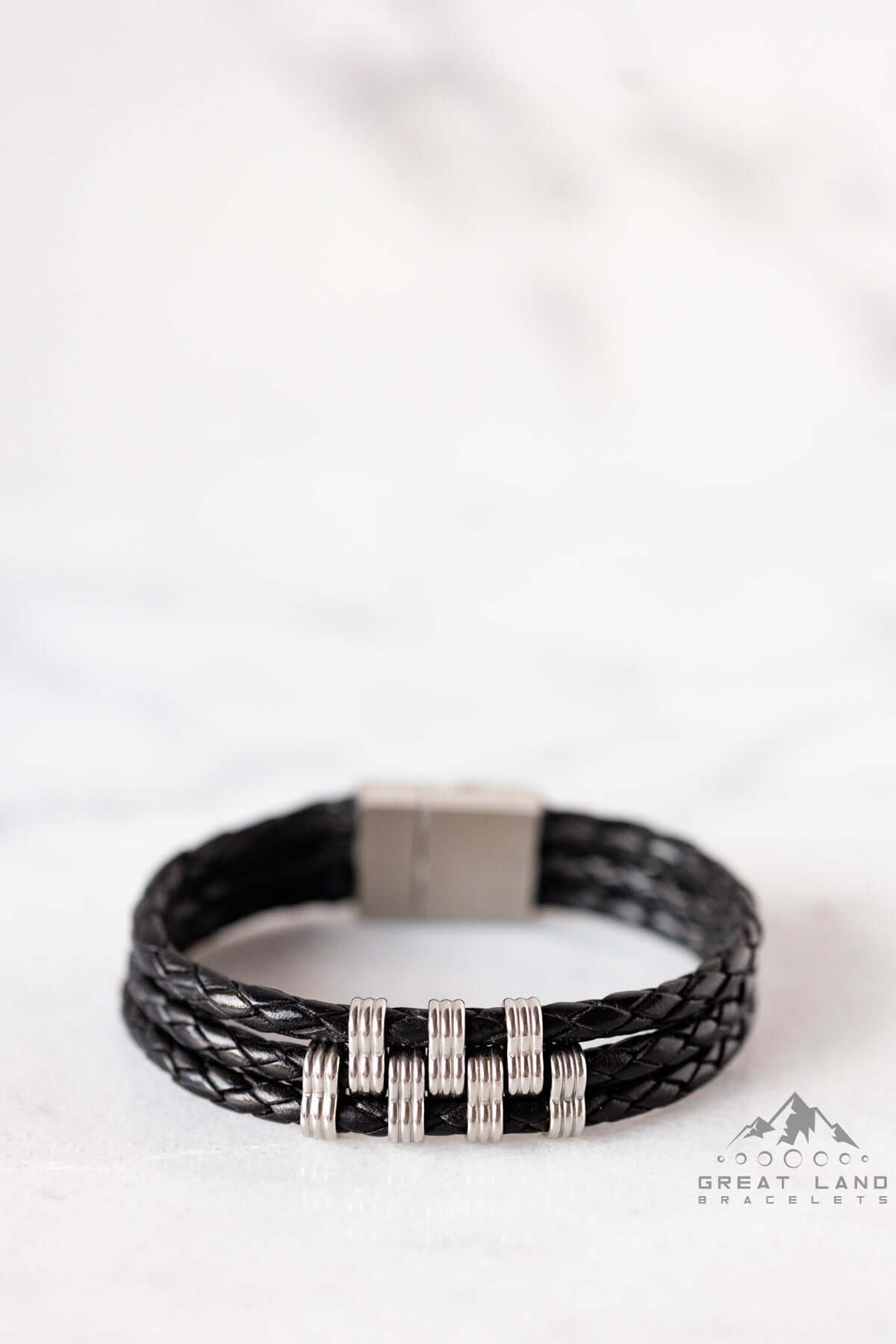
The Brooks Range Bracelet turns the layered shape of the northern mountains into a simple leather design. Three natural leather rings suggest parallel ridges, while stainless-steel beads represent passes through the range. The fixed-size bracelet is offered in multiple sizes, with custom sizing available.
It is a connection for someone who has driven the Dalton, flown above Arctic valleys, worked in northern Alaska, or simply carries a fascination with roadless mountains. Like the range itself, the design is rugged without needing to be complicated.
Carry the northern mountains with you
The Brooks Range reminds us that Alaska is more than a collection of destinations. It is a connected landscape—rivers flowing from a continental divide, caribou following ancient routes, communities sustaining long relationships with the land, and travelers learning that preparation is part of respect.
That is what Wear your Alaska™ means here: carrying the memory of a mountain horizon, the promise of a northern journey, or a personal connection to one of the Great Land’s wildest regions.
Sources and further reading
-
Posted in
Alaska, Alaska Mountains, Alaska Wildlife, Arctic Alaska, Brooks Range, Brooks Range Bracelet, Dalton Highway, Wear your Alaska